Welcome to the March issue of Potter Craft News!
You know what they say—March comes in like a lion and goes out like a lamb. Well, let’s hope the lamb is of the Merino variety or better yet, kid mohair. Isn’t it exciting to have the wide variety of natural fibers that are available today? Your local yarn store or county fair is teeming with luscious natural fibers, from alpaca to yak (and perhaps even pineapple, too). This month we celebrate the exciting spectrum of natural yarns—from plants and animals—with the release of Barbara Albright’s long-awaited book The Natural Knitter.
The Natural Knitter covers everything you would want to know about how these fibers are produced, how their processing leaves a smaller "footprint" on the Earth (Al Gore isn’t the only one with environmental concerns!), and what to look for when shopping for natural yarns, and, of course, it features beautiful knitting projects using these yummy yarns. Author Barbara Albright researched this subject thoroughly and befriended many organic fiber farmers. We’ve listed all the people and the companies Barb profiles in the book here for you. We hope the sneak peeks featured in this newsletter will excite you when you see how all-natural fibers can make a difference—both in your knitting and in the health of our planet.
Happy crafting!

Rosy Ngo, Editorial Director
|
|
"Considered an animal fiber, silk is produced by the silkworm—which is not really a worm at all, but a caterpillar that spins a cocoon for protection as it changes from a caterpillar to a moth."
—The Natural Knitter

Visit the websites of
some of our current & upcoming authors:
Nancy Alden
Julie Carles &
Jordana Jacobs
Wenlan Chia
Compai
Suss Cousins
Fiona Ellis
Kay Gardiner &
Ann Shayne
Berta Karapetyan
Eugenia Kim
Lion Brand Yarn
Nikol Lohr
Margrit Lohrer
Tara Jon Manning
Annie Modesitt
Jillian Moreno &
Amy R. Singer
Ashley Paige
|

Why Buy Organic?
There are several reasons to knit with organic yarn.
By purchasing organic fiber, you are supporting a system of agriculture that works to build healthy soils and a healthy environment. This type of agricultural system does not use toxic inputs that can result in the contamination of the earth, air, and water through the use of toxic pesticides and fertilizers. It is a choice that nurtures nature and celebrates the naturally good things in life.
For people with multiple chemical sensitivities, organic fibers are a great choice. Think about it: Some people say they are allergic to wool, but is it the wool or is it the sprays with which the animal was treated or the chemicals in the soaps or oils with which the wool was processed? Or is it an allergy to a chemical dye or a moth-proofing finish? The structure of the wool’s fiber is very porous and you can never wash out everything that has come into contact with it. Organic yarn also just looks and feels great!
How organic is your yarn? Click here to find out!
|
 |
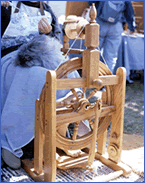 |
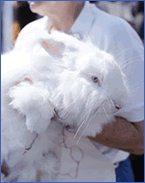
| Angora rabbits not only make fine pets, the are also the source of a fiber that is luxuriously warm and soft. Oftentimes the angora rabbit fur can be combed directly from the rabbit and put onto the spinning wheel. |
|
|

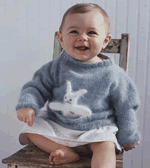

Bodacious Bunny Baby Set from
The Natural Knitter

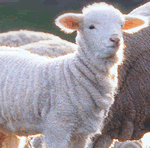
Click here to make this your new desktop wallpaper.
 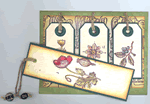
Botanical Bookmark Card
Crafted by:
Bridget P.
Itasca, IL
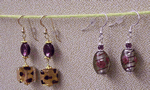
Earrings
Crafted by:
Jenny F.
Rye Brook, NY
Share your projects with us! Email us a photo of something you made from a Potter Craft book, and we'll post it in our gallery.

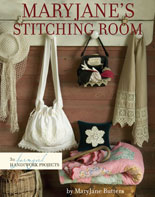
Handiwork projects inspired by life on the farm. Visit MaryJane Butters at
www.maryjanesfarm.com
|